
The CDD numbers tell you what. Investors want to know how.
Every deal team scrutinises ARR, net revenue retention and pipeline coverage. Financial due diligence confirms those numbers are real. What it rarely confirms is whether they are repeatable.
Two companies can post identical growth. One has a defined funnel, a forecast built on evidence, and a CRM that reflects reality. The other hits its number through founder-led deals, heroic reps and spreadsheets nobody else can read. On paper, they look the same. After the deal closes, they behave very differently.
That gap is where revenue engine due diligence earns its place. For venture capital and private equity investors, understanding how revenue is generated, not just how much, shapes the valuation, the value creation plan and, ultimately, the exit.
Why the 'how' matters to investors
The quality of a revenue engine affects returns at every stage of the investment.
Valuation. A growth story built on a repeatable, well-instrumented engine deserves more confidence than one built on a few individuals. Knowing which you are buying informs price and structure.
Value creation plan. Most plans assume growth from new logos, expansion, pricing or new markets. Each assumption depends on commercial capability that may not exist yet. Diligence tells you what needs building and how long it will take.
First 100 days. Without a baseline, the new leadership team spends its first quarter arguing about data instead of acting on it.
Exit. The next buyer will run the same questions. Clean data, a credible forecast and a documented operating model make the equity story easier to tell and harder to discount.
In short, revenue operations for private equity and venture capital is about de-risking the growth you are paying for.
Five ways RevOps expertise supports investors and portfolio companies
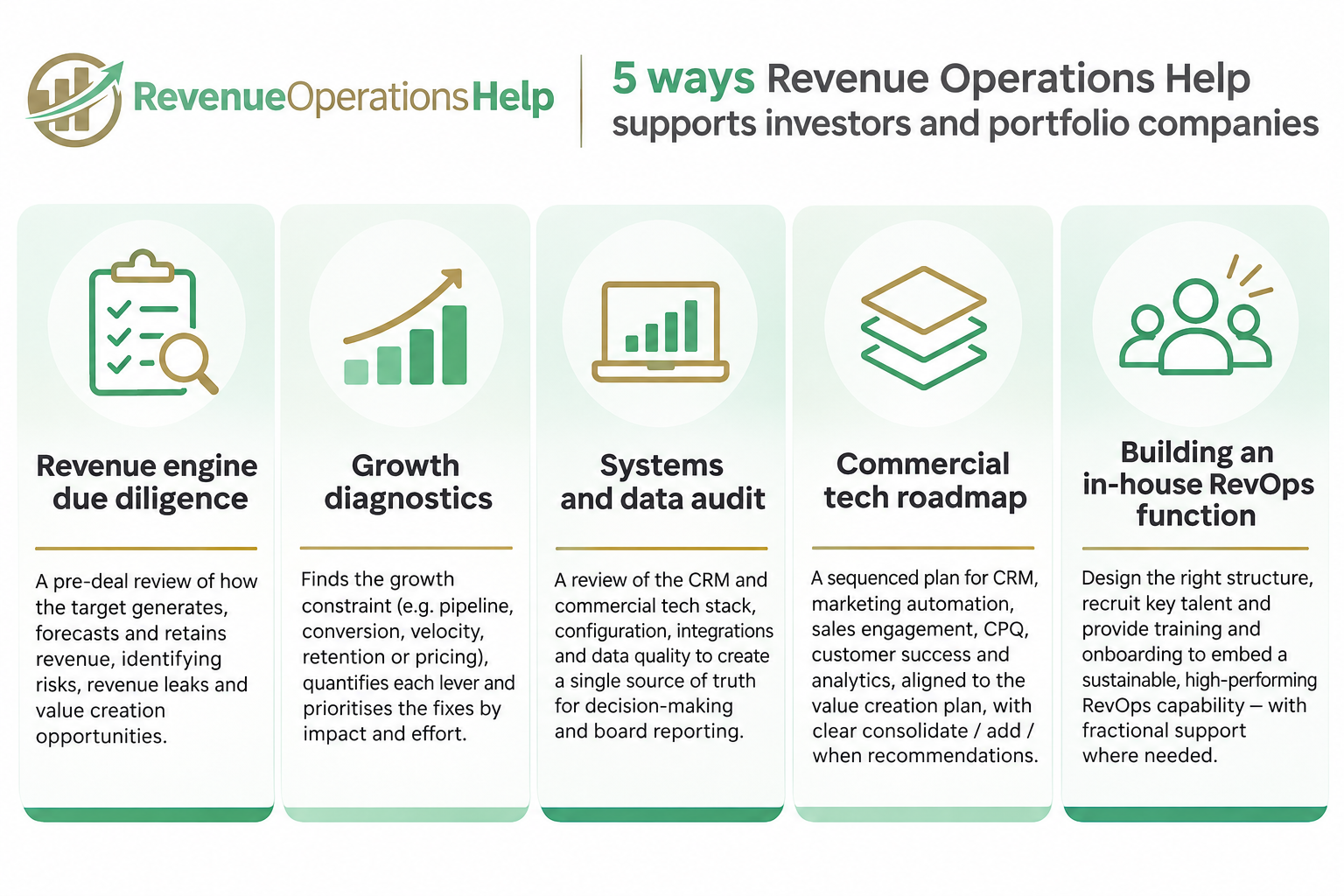
1. Revenue engine due diligence
A pre-deal review of how the target actually generates, forecasts and retains revenue. It complements financial and commercial due diligence by looking under the numbers:
How the funnel is defined, and whether stages reflect real buyer progress
How the forecast is built, and how it has performed against actuals
How dependent revenue is on the founder or a few top performers
Whether CRM data supports the metrics in the data room
How sales, marketing and customer success hand off, and where revenue leaks
The output is a clear view of risk, a set of questions for management, and early input into the value creation plan.
2. Growth diagnostics
Post-close, or when growth stalls mid-hold, a growth diagnostic finds the constraint. Is the problem pipeline generation, conversion, deal velocity, retention or pricing? The diagnostic quantifies each lever from the company's own data and ranks the fixes by impact and effort, so the board can fund the right initiatives first.
3. Systems and data audit
A CRM and systems audit reviews the commercial tech stack, its configuration, integrations and data quality. Typical findings include duplicate or conflicting records, unused tools still being paid for, manual workarounds that hide in spreadsheets, and reporting that cannot be reconciled with finance. Fixing these creates the single source of truth that board reporting depends on.
4. Commercial tech roadmap
Portfolio companies often buy tools faster than they adopt them. A commercial technology roadmap sequences investment in CRM, marketing automation, sales engagement, CPQ, customer success and analytics against the value creation plan. It shows what to consolidate, what to add and when, so spend follows strategy rather than individual requests.
5. Building an in-house RevOps function
Consultants should leave a capability behind, not a dependency. Support here covers:
Design: the right RevOps structure for the company's stage, and where it reports
Recruitment: role profiles, interview frameworks and hands-on support hiring a Head of RevOps or first analysts
Training and onboarding: documented processes, playbooks and coaching so the new team owns the operating model from day one
For portfolio companies without the scale for a full team, an interim or fractional RevOps lead can bridge the gap until a permanent hire is in place.
Where each service fits in the investment lifecycle
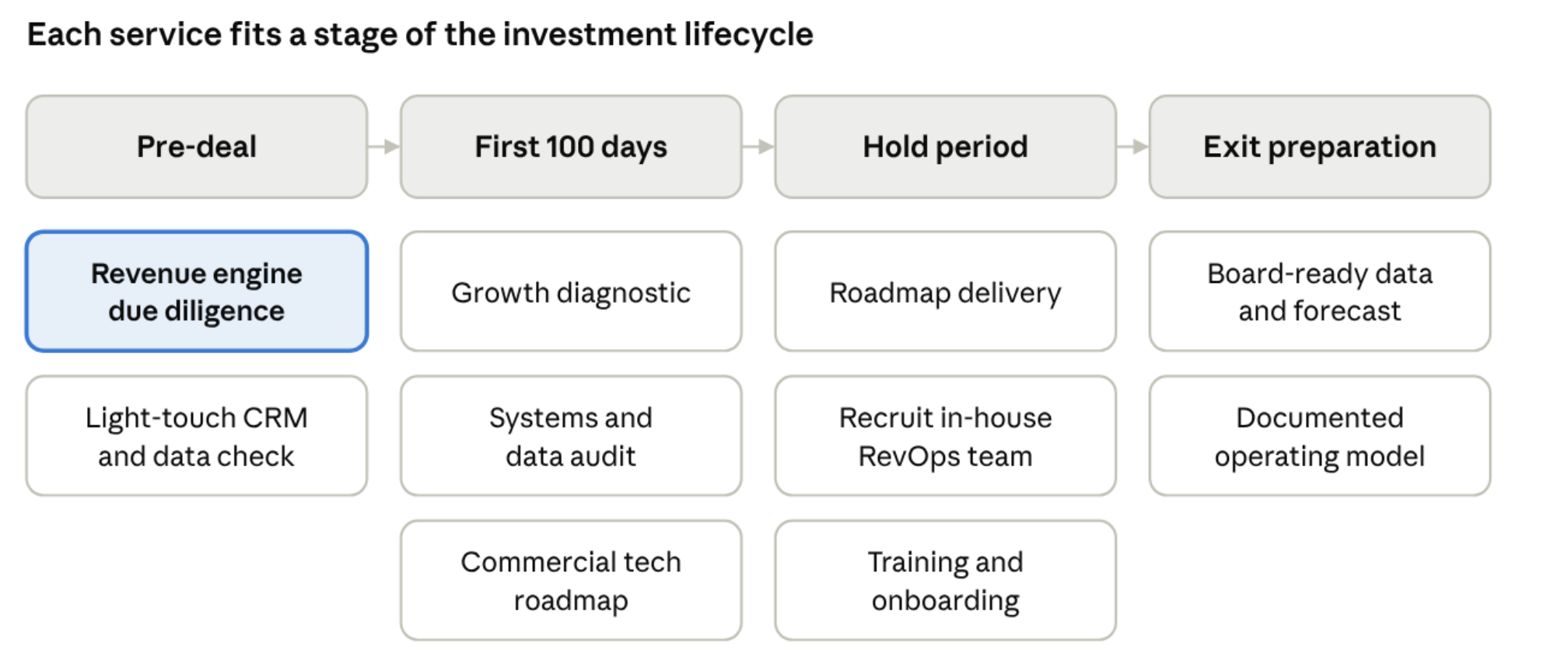
Diligence sets the baseline before the deal. The first 100 days turn findings into a plan, the hold period builds lasting capability, and exit preparation makes the engine easy for the next buyer to underwrite.
Red flags to look for in a revenue engine
These do not kill a deal, but each one should change the price, the plan or the questions you ask management:
The forecast is a roll-up of rep opinions, with no stage criteria or inspection
A large share of new revenue traces back to the founder or one or two people
Pipeline numbers in the board pack cannot be rebuilt from the CRM
Marketing and sales report different conversion rates for the same period
Churn or downgrade risk is discovered at renewal, not tracked before it
The tech stack has grown tool by tool, with overlapping licences and no owner
There is no RevOps owner, or RevOps is a single admin buried in tickets
Each flag points to a specific fix. Finding them before the deal closes means the fix is priced in and planned, not discovered in quarter two.
Invest in the engine, not just the numbers
Investors are skilled at testing what a company has achieved. The harder question is whether the commercial engine can deliver the next stage of growth under new ownership. Revenue engine due diligence answers that before the deal. Growth diagnostics, systems audits, a commercial tech roadmap and a strong in-house RevOps team make sure the answer improves during the hold.
If you are evaluating a target or supporting a portfolio company that needs its revenue engine to scale, let's talk.