
A fractional Chief Revenue Officer (CRO) should leave you with a revenue system that keeps running without them, built by someone who does the work rather than advises on it.
Builder, not advisor
I am not the person who shows up with a 60 page strategy deck and leaves. I roll my sleeves up, get into the CRM, the forecast and the comp plan, and build the thing with your team.
My ego sits at the door. The goal is a revenue engine that works when I am not in the room, and that your team can run, explain and improve.
What I leave to you is the dazzle. Founders are the best closers of key accounts, the big logos and the vision story, and that energy is hard to copy. I build the system underneath so that energy lands in a pipeline that is clean, forecastable and repeatable.
Why a strategic RevOps leader is the right profile
A fractional CRO job is mostly systems work: find where revenue leaks, fix the process, make the numbers trustworthy. That is what a strategic, data-driven RevOps leader does every day.
RevOps sees the whole funnel, from first touch to renewal, so there is no blind spot between marketing, sales and customer success. The forecast is built from data rather than gut feel, and the comp plan is designed against what the numbers say actually drives behaviour.
I also think more CROs are now coming up through RevOps, and a fractional seat is a natural place to start. The job rewards someone who can diagnose quickly, build fast and prove the result in the data.
A few names include Conor Forde (Aiven) who came from a Business/Sales Operations background, Erica Anderson (Notion), formerly VP of Sales Operations at GitHub, and Nicholas Erdenberger (dbt Labs), formerly Director of Revenue Operations at Heap. It also lists CROs who came up through sales operations, including Lindsey Scrase at Checkr and Channing Ferrer at Semrush.
When should a startup hire a Chief Revenue Officer?
Hire a Chief Revenue Officer when founder-led sales has stopped scaling and nobody owns the revenue number, the forecast or the process behind them. If you need that leadership now but a full-time hire is not yet justified, a fractional CRO is the faster, lower-risk way in.
A fractional CRO is the right call when you need senior revenue leadership now but a permanent hire is not yet justified. Typical fractional engagements run 10 to 25 hours a week, and a full-time search can take two to six months (Go Fractional).
Founders usually reach for one in these moments:
Founder-led sales has hit a ceiling, and the next stage needs a process, not more hustle.
There is no CRO, or in the absence of a CRO, nobody owns the number, the forecast, or the revenue plan.
A Series A or Series B is coming, and the revenue story needs data behind it.
The team is growing and hiring; comp and quota decisions are being made on instinct.
You want to build the engine first, then hire the right full-time CRO into something that works.
What professionalising sales at a startup involves
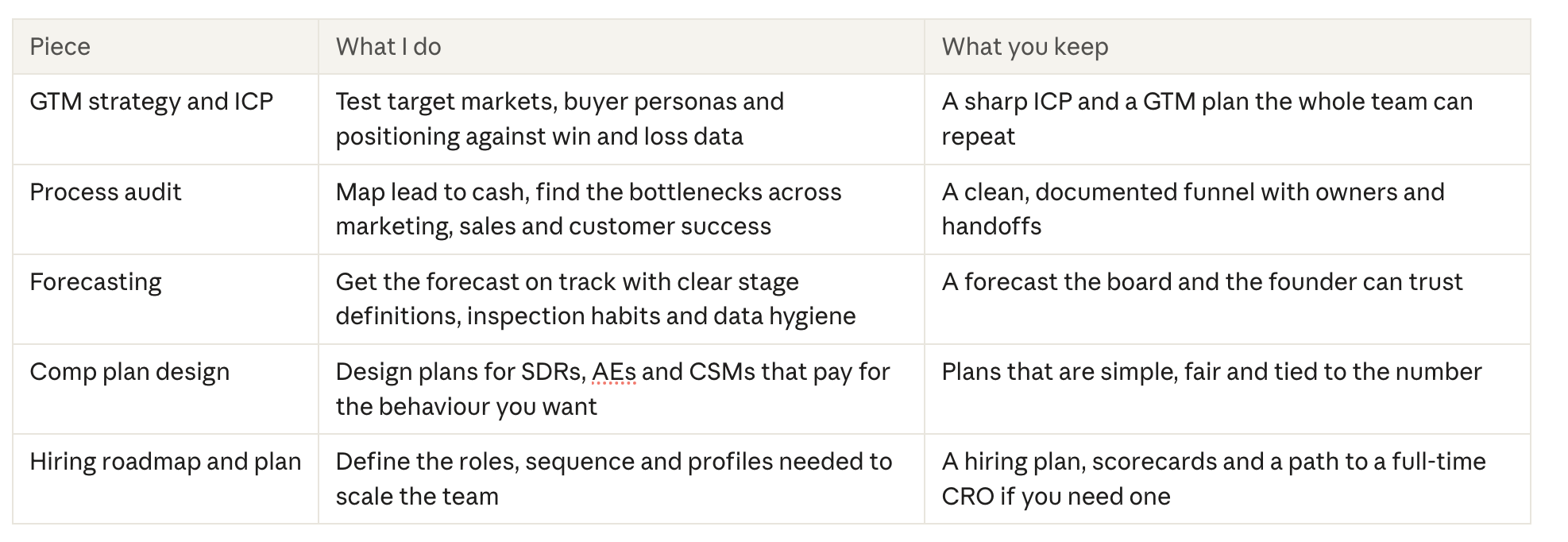
Professionalising sales at a startup comes down to five pieces, and each one ends in something your team owns.
Fractional Chief Revenue Officer FAQ
What does a fractional CRO do?
A fractional Chief Revenue Officer owns the revenue system part time: go-to-market strategy and ICP, the sales process, the forecast, comp plans and the hiring plan. The aim is to build something the team can run without them.
What does professionalising sales at a startup mean?
Professionalising (or professionalizing) sales means replacing founder instinct with a repeatable system: a clear ICP, defined pipeline stages, a forecast people trust, a fair comp plan and a plan for who to hire next.
What is the difference between a fractional, interim and full-time CRO?
A full-time CRO owns revenue permanently. An interim CRO works at or near full time for a set period, often to cover a departure or a transition. A fractional CRO works part time and ongoing, commonly 10 to 25 hours a week (Go Fractional).
How much does a fractional CRO cost in the UK?
Published UK day rates for fractional and contract CROs are around £900 to £1,500 (fractional.quest, citing Intelligent People). Treat that as indicative, because scope and days per week vary a lot.
Can a RevOps leader become a CRO?
Yes. Several CROs came up through revenue or sales operations, because the job is largely systems work: finding where revenue leaks, fixing the process and making the numbers trustworthy. What matters is showing you have owned revenue outcomes, not only reported on them.
The handoff
The best sign of a good fractional engagement is that you need me less each month. By the end you have playbooks, dashboards, a comp plan and a hiring roadmap that your team runs on its own.
If you then want a full-time CRO, I will help define the profile and the structure so that person walks into a working engine. If you do not, the engine keeps running.
If you are a founder with a revenue number to hit and a system that is not there yet, let's talk.
About the author: Marissa is a RevOps and commercial leadership professional based in London who builds repeatable revenue systems for startups and scale-ups.
Other Articles Worth a Read
Go Fractional: What is a Chief Revenue Officer for engagement lengths and search timelines
Altruistiq's Fractional CRO posting and the UP.Labs CRO posting for the scope of work described above
Found HQ: Why the new path to CRO is through RevOps for the CROs with RevOps and sales operations backgrounds